Key takeaways
- E-invoicing is a hot topic with the introduction of Belgium’s official mandate in 2026, but the concept of e-invoicing, or electronic data transfer, has been around for a long time. It’s impact in Mexico was significant for domestic taxation and resulted in further international investment.
- Hidden benefits like compliance and fraud protection make e-invoicing beneficial for organizations at the micro level. Organizations using NetSuite will realize complete audit trails that include e-invoicing.
- Preparing for e-invoicing adoption requires a full assessment, establishing a timeline, evaluating your tech stack, and communication with your vendors to ensure full compliance.
An introduction to e-invoicing
Electronic invoicing, or e-invoicing, is nothing new. We often think of Europe as being a leader in all things digital, but other countries have had e-invoicing for years. Mexico has had the CFDI (Comprobante Fiscal Digital por Internet), since 2004, and various Latin American countries followed suit. The impacts for Mexico were quickly felt; a study from Harvard suggests the tax-to-GDP ratio rose four percentage points from 2012 to 2017, and total tax evasion fell from 35% to 16%, thanks to a significant increase in tax revenue after e-invoicing was made mandatory. In addition, a more stable economic environment encouraged increased foreign investment.
For companies and their customers, the benefits are also felt; validation reduces errors, network delivery reduces fraud exposure, structured data formats improve accuracy, and a stronger audit trail is always maintained.
In times of economic volatility, governments need to look for further ways to guarantee tax revenue. Because of this, the e-invoicing mandate will only continue to grow beyond Belgium throughout 2026 and beyond. Here is what you need to know.
01: What is e-invoicing?
Everything you need to know
E-invoicing refers to the exchange of invoice data in a structured, machine-readable format—typically XML or similar standardized formats—rather than unstructured documents like PDFs or paper invoices. Unlike traditional invoicing where a PDF is emailed or scanned, e-invoicing transmits invoice data directly between systems using a secure network and in a format that can be validated, processed, and reported to tax authorities automatically.
This also means e-invoicing mandates require anyone taking part in the financial system to utilize a means of processing e-invoices, usually an enterprise resources planning software (ERP) or an accounting software with e-invoicing capabilities.
Characteristics of e-invoices:
- Structured data format: Invoice information is transmitted as data fields (vendor name, invoice number, line items, tax amounts) rather than images or text documents
- Government validation: Many e-invoicing systems route invoices through government portals for real-time tax validation before delivery to the buyer
- Tamper-proof: Once validated, e-invoices cannot be altered without detection, ensuring data integrity
How are e-invoices different from PDFs?
Invoices provided as traditional PDF documents, even when sent electronically, do not fit the definition of an e-invoice. Why? Because PDFs require the recipient to manually extract the data from the invoice (or use an automation tool like Invoice AI to extract it).
E-invoicing eliminates the extraction step entirely, by transmitting the invoice data in a format that systems can read directly. It also keeps invoice data secure, and unable to be tampered with.
| Aspect | PDF or traditional invoices | e-invoices |
| Format | Unstructured (image, text) | Structured (XML, JSON) |
| Data Extraction | Manual entry or OCR required | Direct system integration |
| Tax Validation | Manual or post-processing | Real-time government validation |
| Editability | Can be altered after creation | Tamper-proof once validated |
| Compliance Reporting | Manual aggregation | Automatic government reporting |
Why governments are mandating e-invoices
Governments and tax authorities are driving the adoption of e-invoicing, to close gaps in taxation, reduce fraud, and improve the efficiency of tax collection. By requiring invoices to be validated through government systems in real-time, authorities gain immediate visibility into transactions.
Tax evasion on goods and services will become nearly impossible with e-invoicing mandates, ensuring secure invoice data is already logged and registered. It also has the additional upside of reducing the administrative burden for both businesses and tax authorities. For businesses, the system entirely removes manual invoice processing, ensuring invoice data is always accurate.
02: Regional adoption—where e-invoicing is happening and why
The European Union
While individual countries have imposed various e-invoicing systems throughout the last 25 years, the European Union has been focused on a mandate for years. Individual member states have implemented e-invoicing in various ways, and nations continue to roll out various requirements for the near future.
Current e-invoicing landscape in Europe:
- Italy: Mandatory e-invoicing for B2B and B2G transactions since 2019
- France: Phased rollout beginning 2026, with full B2B mandate by 2027
- Germany: Mandatory for B2G transactions; B2B requirements are going through a phased implementation that began in January 2025
- Spain: Mandatory for B2G; expanding to B2B transactions
- Poland: Mandatory e-invoicing through the KSeF platform is in place for taxpayers, and B2B e-invoicing is starting in 2026 with a phased roll out
- Belgium: Belgium has made e-invoicing mandatory for all VAT registered businesses since January 2026
- Netherlands: Mandatory for B2G; B2B e-invoicing is available, but not currently mandatory
- Luxembourg: Mandatory for B2G, no other phases currently planned
Each country within the EU has adopted slightly different technical standards and implementation timelines, creating complexity for multinational organizations operating across multiple EU jurisdictions. Countries also have different tax requirements, which add additional complexity to processing e-invoicing data.
Why US adoption of e-invoicing has been slower
Unlike Europe’s VAT-driven mandates, the United States has not implemented any e-invoicing requirements at either the federal or state level. There are a number of factors at play when looking to implement B2B e-invoicing:
- Tax structure differences: The US sales tax system is decentralized across states, making federal mandates more complex.
- Voluntary adoption: E-invoicing in the US has been driven by business efficiency rather than regulatory compliance
- Industry-specific standards: Sectors like healthcare (EDI 810) and retail have adopted electronic invoicing independently
- No VAT gap pressure: Without a VAT system, the US lacks the same tax collection incentives driving European mandates
However, US-based companies with European operations have some choices to make. If your organization does not have a legal entity presence in a jurisdiction with an e-invoicing mandate, there are still benefits to having it set up. If your suppliers require e-invoicing for their own business, working with non-compliant customers would require them to send invoices using non-standard methods, which could cause invoicing issues for your company, resulting in missed invoices or late payments. And the underlying issue, which is that friction can damage your vendor relationships.
How international e-invoicing mandates impact global operations
Organizations operating internationally face a patchwork of e-invoicing requirements:
- Multi-jurisdiction compliance: Different countries require different formats, validation processes, and reporting timelines
- Vendor coordination: Both buyers and suppliers must support e-invoicing for transactions to flow smoothly
- System readiness: ERP and AP automation platforms must support multiple e-invoicing standards
- Phased implementation: Mandates often roll out in phases, requiring ongoing monitoring and adaptation
03: The hidden benefits – Compliance and security advantages of e-invoicing
Built-in fraud prevention
The structured, validated format of e-invoices makes invoice fraud significantly more difficult. Traditional PDF invoices can be easily manipulated: amounts changed, line items added, or duplicate invoices created. E-invoices in some regions are validated through government portals and cannot be altered without detection.
In Belgium, they currently use the Peppol 4-corner model. The four corners operate as:
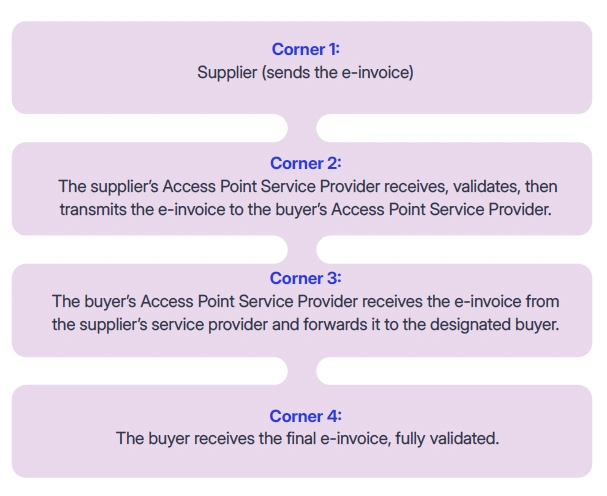
Even then, changes are already planned for future state; Belgium has announced for January 2028, invoice data will be transmitted to the Belgian tax authority almost immediately after issuance, replacing periodic exchanges. This new system will use the 5-corner model, as opposed to the current 4-corner model, where the government acts as an additional intermediary.
Key security benefits:
- Tamper-proof validation: Government systems validate invoice data before transmission, creating an immutable record
- Real-time verification: Tax authorities can cross-reference invoices against reported transactions immediately
- Reduced duplicate payments: Structured data makes it easier to detect duplicate invoice submissions
- Enhanced audit trails: Complete transaction history is maintained in government systems
Improved data accuracy
Manual data entry and OCR processing often introduces errors into datasets: incorrect amounts, misread vendor names, or transposed account codes. E-invoicing eliminates these risks by transmitting data directly between systems, directly from your vendors.
Accuracy improvements:
- No manual transcription: Data flows directly from supplier systems to buyer systems
- Standardized formats: Required data fields ensure completeness and consistency
- Automated validation: Systems can verify data integrity before processing
- Reduced reconciliation needs: Fewer errors mean less time spent investigating discrepancies
Benefits of e-invoicing for AP teams:
- Reduced audit preparation: Complete, validated records are maintained automatically
- Faster processing: Structured data enables faster invoice approval and payment
- Lower compliance costs: Automation reduces manual effort required for tax reporting
04: Prepare your AP operations for e-invoicing
Assess your current state
When introducing any new feature or process, assessing your current state is a crucial first step. Understanding the implications of e-invoicing before mandates are in place will help set your team up for success.
Key assessment questions:
- Do you operate in jurisdictions with existing or planned e-invoicing mandates?
- What percentage of your vendors are prepared to send e-invoices?
- Does your ERP system support structured invoice data formats?
- How do you currently handle multi-jurisdiction tax compliance?
- What AP automation tools are you using, and do they support e-invoicing standards?
Understand your timeline
E-invoicing mandates typically roll out in phases, often starting with large enterprises before expanding to mid-market and smaller businesses. Understanding your timeline helps prioritize preparation efforts.
A typical phased rollout:
- Phase 1: Large enterprises (often 250+ employees or €50M+ revenue)
- Phase 2: Mid-market companies (50-250 employees)
- Phase 3: Small businesses and all remaining entities
Keeping on top of e-invoicing mandates in each jurisdiction where you operate is key to determining when compliance becomes mandatory for your organization.
Evaluate your technology stack
Adopting e-invoicing is entirely dependent on your current setup; ERPs and accounts payable automation solutions must be adapted to suit the requirements of e-invoicing, not just based on your organization but also dependent on geography. Supporting e-invoicing formats also requires integration with government validation systems.
Technology readiness checklist:
- ERP capabilities: Does NetSuite support the e-invoicing formats required in your jurisdictions?
- AP automation integration: Can your invoice processing solution handle structured e-invoice data?
- Vendor onboarding: How will you communicate e-invoicing requirements to suppliers?
- Data mapping: Can your systems map e-invoice data to your chart of accounts and approval workflows?
- Reporting capabilities: Do you have visibility into e-invoice processing status and compliance?
Communicate with vendors
E-invoicing requires coordination between buyers and suppliers. Both parties must support the same standards and formats for transactions to flow smoothly. Creating a vendor strategy is necessary in order to set up e-invoicing correctly, and successfully make this transition.
Vendor strategy:
- Identify critical vendors: Prioritize high-volume or strategic suppliers for early e-invoicing adoption.
- Provide clear requirements: Share technical specifications and a timeline for e-invoicing implementation.
- Offer support and resources: Help vendors understand format requirements and integration options.
- Plan for a transition period: Expect to support both traditional and e-invoicing formats during rollout.
Conclusion: Prepare without panic
E-invoicing represents a significant shift in how invoice data is exchanged and validated, but it doesn’t require a complete overhaul of your AP operations. By understanding the fundamentals, monitoring regional mandates, and ensuring your technology stack can support structured invoice data, you can prepare your organization for e-invoicing without disrupting existing workflows.
Key takeaways:
- E-invoicing is structured data, not just electronic delivery. The shift from PDFs to machine-readable formats enables real-time validation and automated processing
- Europe is early in expanding adoption, but US companies with international operations may still need to comply depending on individual circumstances. Monitor mandates in jurisdictions where you operate and understand where tax implications can arise. If your vendors are facing e-invoicing mandates, complying could also improve your vendor relationships
- Security and compliance benefits are significant. Tamper-proof validation, guaranteed accuracy, and streamlined tax reporting reduce fraud and administrative burden
- Native-NetSuite integration ensures seamless adaptation. Platforms like Charted that operate entirely within NetSuite can support e-invoicing without external integrations or workflow disruption
As e-invoicing mandates expand, finance teams who understand the fundamentals and prepare their technology stack now will be able to adapt smoothly.
Are you prepared for e-invoicing?
Charted Invoice Automation provides NetSuite-native support for both traditional and e-invoicing formats, ensuring your team can adapt to regulatory changes without disrupting existing workflows.
Ready to discuss your path to e-invoicing? Contact us to learn more.
About Charted
Charted clears the path for finance teams with AP Automation solutions built directly into your NetSuite environment, providing real-time clarity on every invoice, approval, and payment. Eliminate manual data entry withAI-powered capabilities and automation designed to accelerate your month-end close. Enable the most complex approvals and global, multi-entity workflows. Charted was born from years of hands-on implementation and consulting expertise, bringing you a one-stop-shop for everything NetSuite.
To find out more, please visit www.charted.com.
©2026 Charted (031226)