
Growth doesn’t necessarily mean your finance team needs to get busier. Yet for many NetSuite customers, every new vendor, customer, entity, and tool adds another place where accounts payable (AP) and accounts receivable (AR) data can drift out of sync. AI-powered AP and AR automation in NetSuite changes that by keeping both sides of the ledger in one system.
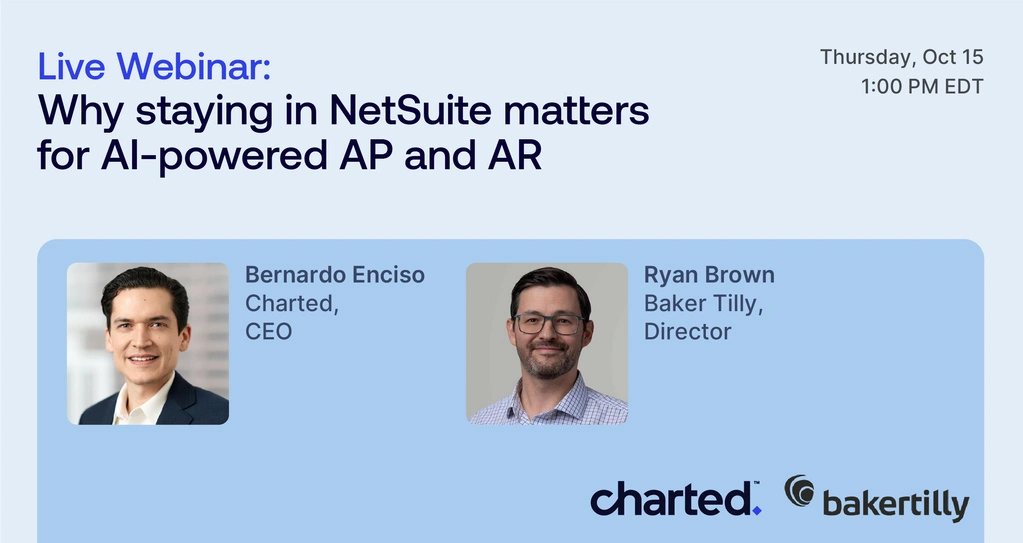
On October 15, 2026, Charted and Baker Tilly are hosting a live fireside chat on what it looks like in practice when automation runs natively inside NetSuite. The session covers how AI agents can handle vendor bill matching, customer invoice coding, exception handling, and collections without middleware, separate logins, or reconciliation gaps. Attendees can earn 1 CPE credit.
Why do disconnected AP and AR tools create reconciliation gaps?
Disconnected tools create gaps because each one keeps its own copy of your data. When AP runs in one platform, AR in another, and NetSuite serves as the system of record, every sync becomes a chance for timing differences, mapping errors, and duplicate records.
The symptoms are familiar to most finance teams:
- Month-end close stretches out while staff reconcile what each system says against the general ledger.
- Cash visibility lags because payables and receivables are updated on different schedules.
- Users juggle multiple logins, and admins maintain multiple integrations.
- Audit trails split across platforms, making it harder to show who did what and when.
Adding AI on top of a fragmented stack can amplify these problems. An AI agent working from a stale or partial copy of your data produces answers that still need to be checked against NetSuite.
What does AI-powered AP and AR look like inside NetSuite?
Native AP and AR automation means the AI works directly on NetSuite transactions, so every action is real-time and GL-impacting from the start. There is no export, no sync window, and no second source of truth to reconcile.
In the webinar, Charted and Baker Tilly will show how their capabilities work together on a shared, real-time data set:
- AP with Charted: AI-powered invoice capture, vendor bill matching, and exception handling inside NetSuite, so AP teams spend their time on the bills that actually need a human decision.
- AR with Baker Tilly: AI-enhanced AR automation that supports the sales to cash lifecycle, helping teams speed up cash application, revenue recognitions, amendments, and renewals.
Because both sides of the ledger live in the same system, finance leaders get a single, current view of what is owed and what is coming in. That view supports better cash forecasting and faster decisions.
How do MCP-enabled AI agents support cross-team analysis?
Model Context Protocol (MCP) is an open standard that lets AI agents connect to business systems like NetSuite in a structured, permissioned way. Instead of copying data out to an external tool, an MCP-enabled agent queries and acts on NetSuite data where it lives.
For finance teams, that opens up practical use cases such as flux analysis across AP and AR. An agent can compare period-over-period changes, surface the transactions driving a variance, and help controllers and AP leads investigate together from the same numbers.
The session will also cover the controls that make this safe for finance:
- Tiered permissions so agents can only see and do what a given role allows.
- Full audit trails so every agent action is logged and reviewable.
- Human oversight for transactions and decisions that require approval.
How does staying in NetSuite affect total cost of ownership?
Keeping AP and AR automation inside NetSuite reduces the number of systems you license, integrate, secure, and support. Every external platform brings its own subscription, connector maintenance, user provisioning, and security review.
A native approach consolidates that overhead. It also makes AI adoption easier to govern, because the agents inherit the roles, permissions, and audit history your team already manages in NetSuite. The webinar will share practical ideas for simplifying your stack, reducing processing time, and keeping AI adoption safe and auditable as you scale.
What will you learn, and who should attend?
After the session, participants will be able to:
- Identify how native NetSuite integration improves data visibility and reduces reconciliation gaps between AP and AR for software finance teams.
- Describe the AI-driven capabilities Charted and Baker Tilly each bring to AP and AR automation.
- Explain how MCP-enabled AI agents support cross-team analysis and transaction processing while maintaining permission controls and audit trails.
The fireside chat is built for:
- Controllers, CFOs, and revenue operations and finance leaders evaluating how to scale AP and AR without adding headcount or systems.
- AP and AR practitioners who want less manual matching, coding, and chasing.
- NetSuite admins and operators responsible for keeping integrations, permissions, and data clean.
- Software and technology finance teams facing fast growth and complex revenue and vendor activity.
Register for the webinar
Register for the live virtual fireside chat, taking place on October 15 from 12 to 1 p.m. CT, and gain 1 CPE credit (Field of study: Computer Software & Applications).
If your AP and AR processes are getting harder to manage as you grow, this session will show you a simpler path that keeps everything in NetSuite. Save your seat and bring your questions for the live Q&A.