NetSuite-Native AP Automation
Growing invoice volume. Same AP team. There’s a better answer than another hire.
Your AP team handles the same manual work every month. Vendor onboarding. Invoice entry. Approval chasing. Payments across platforms. Charted automates all of it inside NetSuite: invoice receipt to vendor bill, without adding headcount. Your team handles exceptions. Charted handles the rest.
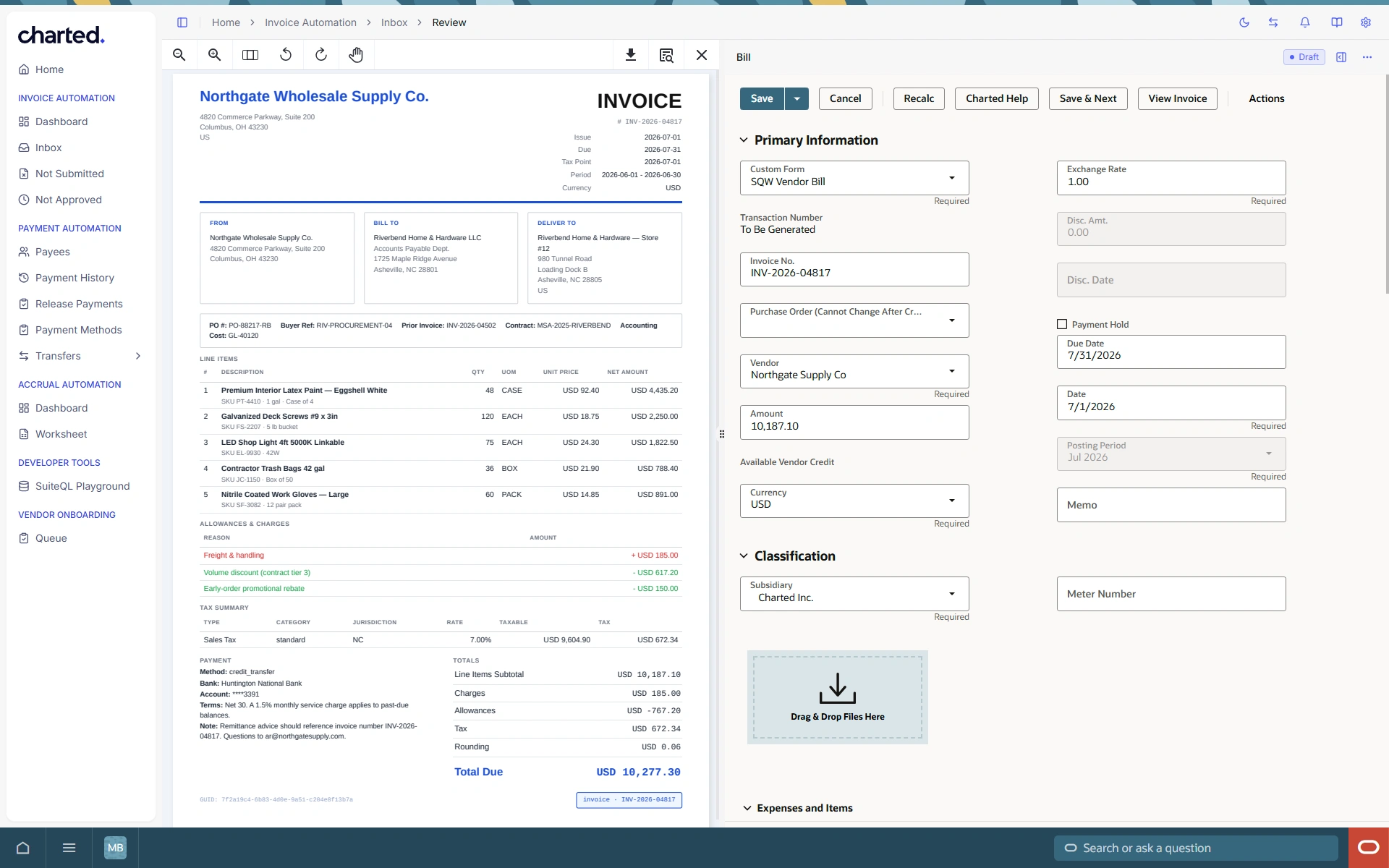
- Invoices captured, coded, and matched automatically. Your team reviews exceptions, not every bill.
- Approvals route and close without email chains. Every decision happens inside NetSuite.
- Payments processed end to end without leaving your suite. ACH, check, and international.
- Month-end close in hours, not days. Every transaction is reconciled as soon as it’s approved.
You can update your subscription preferences at any time. Your information will be processed in accordance with our Privacy Notice.
Trusted by finance teams at


Invoice Automation. Payment Automation. Accrual Automation. All inside NetSuite.
Charted runs as a certified SuiteApp inside the NetSuite environment your finance team already uses. Every invoice, approval, payment, and accrual estimate lives on the native record. No connectors, no middleware, no data sync.
Charted automates the full accounts payable (AP) lifecycle in one system, so nothing has to travel between platforms to get finished.
Certifications and compliance
Certified SuiteApp
NetSuite Next
SOC 2 Type 2
GDPR-ready
I’d heard that many companies say it takes about 6 months for the OCR technology to learn your business. The second time I processed bills with Invoice AI, it scanned 100% of the information needed.
Eric Symons, Accounting Manager, East West Partners
Every growing AP team hears the same three suggestions
Volume grows. The team doesn’t. So, the advice trickles in: hire another AP specialist, bolt on a connected tool that lives somewhere else, or accept that month-end takes a week.
None of those suggestions fix the reason accounts payable is slow.
The integration toll nobody puts on the invoice
Most AP automation lives outside NetSuite. Invoices get captured somewhere else, GL coded somewhere else, and approved somewhere else, then synced back into NetSuite when the work is done.
Every back-and-forth move your data makes is an opportunity to arrive late, arrive wrong, or not arrive at all.
You pay for that gap twice—once in the license, and again in the hours your team spends reconciling two systems that should have been one from the start. Your IT team pays a third time, maintaining connectors that break on upgrade.
Better configuration does not close the gap. A tool that lives outside NetSuite will always need a bridge back in.

The only AP platform that never makes you leave NetSuite
Charted was built as a SuiteApp, designed solely for NetSuite. Invoices land on the native vendor bill. Approvals write to the NetSuite record. Payments originate from your own bank accounts. There is no second system to reconcile, because there is no second system.
Once it connected with our respective bank accounts, our users and AP specialists would not have to leave the NetSuite interface to make payments, which was very valuable.
Alex Szigety, VP of Finance, Petauri
Where NetSuite Bill Capture stops
If your team captures vendor bills with NetSuite Bill Capture, you already made the right call. You kept accounts payable inside the system your finance team works in every day, with nothing sitting in between.
Bill Capture was built to do one job: Get the invoice in. It does that job.
The rest of the lifecycle is where the stack starts growing. Approvals become a separate add-on. Payments become another. Accrual Automation is not part of that workflow at all. Each piece is a separate purchase, a separate configuration, and a separate audit trail.
Native was the right instinct. The workflow just wasn’t finished.
What Charted picks up
Charted continues where capture ends:
- Real-Time 3-Way Match validates vendor bills against purchase orders and receipts at the line level, with price and quantity tolerances you configure.
- Approval Automation routes to any stakeholder and closes from email, with no NetSuite license required for approvers.
- Payment Automation executes ACH Payments, On-Premise Check Printing, Outsourced Check Processing, and International Payments from your existing bank accounts.
- Accrual Automation builds month-end estimates from data already sitting in NetSuite.
Approval participation can grow without approval costs growing, because Charted charges no per-approver license fee. Platforms that price per approver turn every new reviewer into a line item.
One system. One source of truth.
Our approvals were manually emailing every single person, and while everyone is nice and responds, it would take me an entire day of doing that. I don’t have to do that anymore.
Liz Magee, Accounting Manager, Neurotech
The accruals nobody automated
Month-end arrives and the invoices haven’t. The expense still belongs in the period, so someone builds the estimate by hand: pulling open purchase orders, checking last month’s spend, emailing department heads, and waiting on replies that arrive after the deadline.
Most AP automation platforms skip this work entirely. They stop at the vendor bill, which leaves the hardest part of close exactly as manual as it was before.
Accrual Automation builds estimates from the purchase orders, receipts, and historical patterns already in NetSuite, then posts the journal entries. Because Charted lives on the native record, the accrual uses the same data your financial statements use.
Skip the guesswork. Trust your numbers.
Measured across our customer base
The results finance teams are seeing
80%
Reduction in vendor setup time
Customer average
95%+
Improvement in invoice accuracy
Customer average
75%
Faster approval cycle times
Customer average
Charted powers the full AP lifecycle directly inside NetSuite
Three pillars carry the lifecycle from vendor request to
closed period:
Invoice Automation
Capture, GL coding, validation, and approval routing on the native vendor bill.
Payment Automation
ACH, check, and cross-border payments executed from your own bank accounts.
Accrual Automation
Month-end estimates and journal entries generated from NetSuite data.
Each pillar writes to the same NetSuite record. That is what makes the lifecycle continuous instead of stitched together from parts.
See it in your environment
See it running in NetSuite, not in a slide deck
The demo is not a recorded tour. We configure Charted to your entity structure, run your actual invoices through it, and walk the full cycle from invoice capture to payment in the environment your team will use every day.
How the hardest parts work
The three modules that carry the workload
Invoice AI
Invoice capture, with header and line-level detail pulled from emailed PDFs or drag-and-drop uploads. Invoice AI learns your GL coding patterns from every correction your team makes, so accuracy climbs as volume grows. AI Directions let your team add extraction rules using natural-language instructions, for the fields generic scanning misses: meter numbers, project codes, and custom line detail. Touchless Invoice Processing creates the vendor bill outright for recurring, high-confidence invoices like utilities and software subscriptions.

Real-Time
3-Way Match
Line-level validation against purchase orders and receipts as each invoice is processed, with price and quantity tolerances you configure. Variances route through your approval workflow with justification tracking attached, so the audit trail builds itself as the work happens.

Approval Automation
Approval rules built on amount, department, subsidiary, vendor, or any combination of those, with no scripting and no help from IT. Approvers act directly from email without needing a NetSuite license, and every decision writes back to the NetSuite record.

Real complexity. Verified results.
Over 500 invoices a month, across 120+ legal entities
East West Partners, a real estate development firm, runs accounts payable across more than 120 legal entities inside a single NetSuite environment. After moving to Charted, invoice processing time dropped 70%. No added headcount, and no second system to reconcile.
70%
reduction in invoice processing time
One thing we’ve appreciated about Charted is that they understood who we were and what we were able to do from a technology standpoint, which really helped us in the learning process. They provided detailed information that helped everyone grasp how the solution would work.
Eric Symons, Accounting Manager, East West Partners
Validation from outside Charted
What AP teams say on the SuiteApp Store
I have been doing accounting for over 6 years and Charted AP Automation has been by far one of the most user-friendly system. The support team feels like real humans who care and are extremely helpful and easy to get ahold of.
Accounts Payable Team Lead
Recognized by Deloitte, The FinTech Awards, and Inc. 5000
Deloitte Technology Fast 500
Ranked #158 fastest-growing company in North America, 2025

The FinTech Awards 2026
Finalist, Accounts Payable & Receivable

Inc. 5000
Ranked #1916 among America’s fastest-growing private companies, 2025

What happens next
Here’s how we work
with our customers
Every conversation is built around your specific NetSuite setup.
01
Before the demo, you’ll see the value.
We’ll discuss the barriers your team faces.
We start with your setup: invoice volume, vendor intake, number of entities, and your current approval chain. From there, we’ll work through where the friction is today: manual coding, approval chasing, sync failures, or a month-end close that takes longer than it should.
You’ll leave the call with a clear picture of whether Charted is right for your team.
02
If there’s a fit, you’ll see Charted in your environment.
Once we understand your needs we can share an overview of how Charted uniquely solves those challenges.
Using your actual invoices and everything from our first conversation, you’ll get a live session inside NetSuite configured to your setup. You’ll see your approval workflows, your entity structure, and the full cycle from invoice capture to payment.
Exactly as it would work for your team.
Questions finance teams ask before the call
How Charted compares
NetSuite Bill Capture handles invoice capture. Charted handles the full accounts payable lifecycle: capture, GL coding, line-level validation, approvals, payments, and month-end accruals, all on the native NetSuite record. Connected tools handle more of that lifecycle, but they process outside NetSuite and sync results back, which is where reconciliation work and sync failures come from. Charted has nothing to sync because nothing leaves NetSuite.
There is a scope difference between Charted and Zone & Co. Zone & Co. covers a broad finance stack across billing, payroll, reporting, and AP, built out in part through acquisitions. Charted does one thing: the complete AP lifecycle, built entirely for NetSuite.
That shows up in two practical places. Zone AP Payments is electronic only, so if check printing matters for part of your vendor base, Charted covers that rail inside NetSuite. Charted automates expense accruals from your existing NetSuite data as part of the core AP workflow, so month-end estimates are not a separate manual exercise. Charted has expanded e-invoicing capabilities significantly to cover multiple markets across Europe.
Zone has an established global payment solution for AR as well as broad e-invoicing coverage. If your priority is closing faster with fewer AP tools, Charted is the better fit.
Charted keeps your data in NetSuite. BILL keeps it in BILL and syncs it back.
Three consequences follow. On approver cost, Charted routes approvals with no per-user license fee, while BILL charges per approver every month, so approval costs climb as participation grows. On data ownership, Charted vendor data lives in NetSuite under your control, while the BILL network model keeps vendor data in their system, which becomes a migration problem the day you decide to leave. On reporting, BILL payment records do not carry departments, locations, or classes in NetSuite, so a vendor aging or spend-by-department report needs payments recoded before it is usable.
That last point survives the newer integration. BILL Intelligent Payment Automation brings approvals into the NetSuite interface, but the underlying payment records still do not support those dimensions. Workflow convenience improved. Reporting completeness did not.
Charted runs entirely inside NetSuite as a native SuiteApp. Tipalti is an external platform that integrates with it.
Day to day, that means a team running on Charted stops switching systems and stops waiting on synced status changes. When an external sync fails, invoices, approvals, or payments may not appear correctly in NetSuite, and someone has to troubleshoot the Tipalti integration before anyone can trust the reporting. Charted removes the sync layer, so there is nothing to fail.
Vendor experience differs too. Charted Advanced Vendor Onboarding uses secure, branded forms that write directly into NetSuite, so vendors never create accounts or manage passwords. Tipalti relies on a vendor portal, which adds steps and slows vendor participation.
Where Tipalti wins: global payment breadth. Tipalti offers 50+ payment methods with built-in currency conversion and fraud controls, which suits organizations with highly complex international payment needs. If most of your payments are domestic and your priority is keeping accounts payable inside NetSuite, Charted is the better fit.
Different categories. Ramp is a spend management platform built around corporate cards and employee expenses. Charted does one thing: vendor invoices, approvals, payments, and accruals, inside NetSuite.
Two practical differences matter here. Ramp bill pay runs through the Ramp platform and syncs to NetSuite through an API integration, which also consumes a full NetSuite user license to support it. And because Ramp monetizes card processing, the AP product can start cheap or even free. Running accounts payable across two systems is where that cost reappears: reconciliation time every month, integration maintenance, and two systems for auditors to test instead of one.
To be clear, Charted does not replace corporate cards or employee expense management. Plenty of organizations run Charted for vendor AP and keep a separate tool for employee spend. The question is whether vendor invoice automation belongs inside NetSuite or beside it.
How it works and what happens next
Yes. Charted uses the multi-entity and multi-currency structure already configured in NetSuite rather than maintaining its own. Invoices route to the correct subsidiary based on vendor patterns and rules you set, currency conversion follows your NetSuite configuration, and approval workflows can differ by entity. Approval limits can be set in each approver’s local currency. East West Partners runs Charted across more than 120 legal entities in one environment.
Invoice AI captures header and line-level data with 95%+ accuracy, and improves from there because it learns from every correction your team makes. It maps directly to your NetSuite segments: subsidiary, department, class, location, and custom fields. Across the Charted customer base, invoice accuracy improves 95%+ on average. For the fields generic scanning tends to miss, AI Directions let you add extraction rules using natural-language instructions.
No. Charted operates using standard NetSuite objects and workflows, so it works alongside your existing customizations, scripts, and workflows without refactoring. It stays compatible through NetSuite releases, which means no surprise maintenance when your environment updates.
Teams with straightforward requirements are typically live with Charted in two to three weeks. Organizations with more complex needs, or those in the middle of a full NetSuite implementation, can take more than six weeks. There is no integration to build, so implementation is NetSuite configuration and training rather than platform setup plus connector work. We will give you a realistic timeline on the first call rather than after you sign.
No. Charted Approval Automation sends approvers everything they need by email, including the invoice attachment, and they approve or reject from there. The decision and full audit trail write back to the NetSuite record. Approval costs stay flat as approval participation expands, because there is no per-approver license fee.
Someone from the Charted team reaches out to schedule a conversation about your current setup. There is no automated sequence and no demo you have to sit through first. If there is a fit after that conversation, the next step is a live session inside NetSuite configured to your environment.
Ready to experience NetSuite-native AP automation?
Charted delivers complete AP automation entirely within NetSuite—no integrations, no data synchronization, no switching between platforms. Finance teams gain efficiency, IT teams eliminate maintenance burden, and NetSuite remains your single source of truth.