Contract Intelligence
Vendor contract management and renewal tracking in NetSuite
Charted Contract Intelligence is a native NetSuite SuiteApp that uses AI to extract term dates, auto-renewal language, and notice periods from vendor contracts and tracks every renewal on the vendor record. Vendors, POs, bills, and payments now live in NetSuite alongside the contracts that govern them, so you can track every renewal, term, and decision, all in the same place.
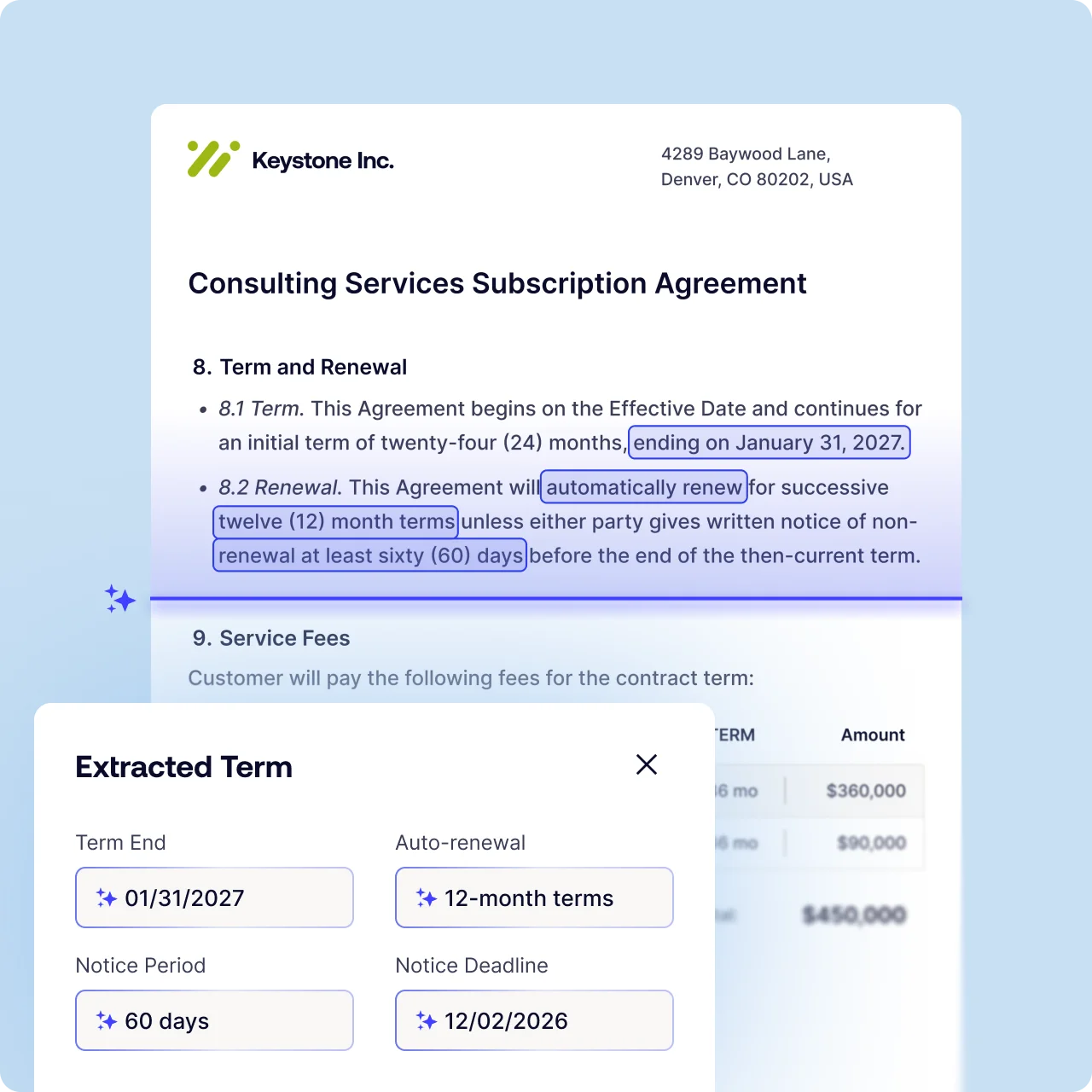
Charted Contract Intelligence
What poor contract management really costs finance teams
50%
of installed software goes unused (Nexthink, 2023). Those licenses still renew on schedule, at a higher price, unless somebody reads the contract before the deadline.
8.6%
of revenue and cost efficiency is lost on average due to poor contracting practices. In more complex industries, this figure can rise to 15% or more. Source: World Commerce & Contracting, 2025
Zero
external systems added. Contracts, extracted terms, renewal dates, and alerts stay inside your own NetSuite instance. No middleware to maintain, no second login.
The cost of auto renewals
Why auto-renewals in vendor contracts go unnoticed
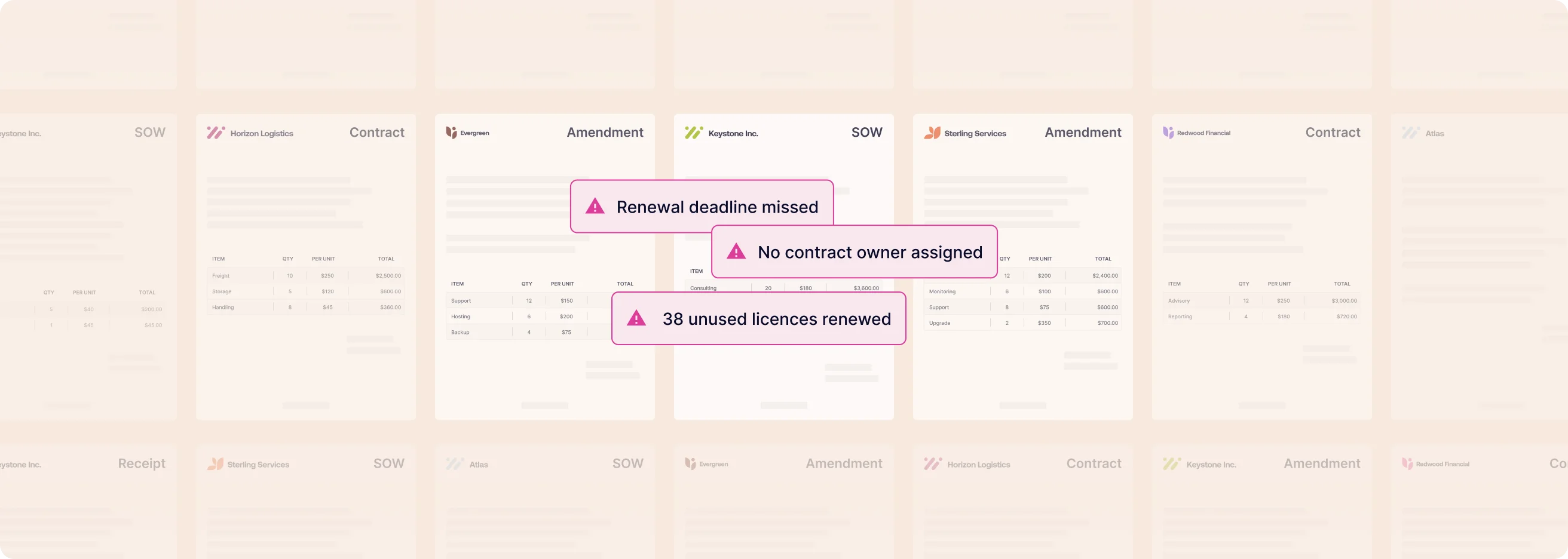
Contract auto-renewal price increases slip past AP
The auto renewal has an automatic price increase, and the notice window closed before anyone read the clause. The bill comes in at the new rate and AP codes it like any other recurring spend. Your opportunity to negotiate was 60 days before the deadline, and a spreadsheet of renewal dates only works if someone remembers to open it in time.
Licenses nobody uses, renewing on schedule
The team that asked for the tool moved on, and the licenses are still active. The renewal clears all approvals because the amount is close to last year’s amount and nothing on the vendor record says the licenses went unused. If the date had surfaced before the invoice, someone would have cancel the contract.
Contract renewals without an owner
The signature is on the document, the person is not in the directory, and the calendar reminder went to their mailbox. AP knows what the vendor billed, procurement knows roughly when the deal was signed, and nobody owns the decision. Ownership that lives in one person’s head is the failure mode.
Charted Contract Intelligence
How vendor contract management works in NetSuite
Upload a vendor contract to NetSuite and Charted Contract Intelligence extract the term dates, auto-renewal language, and notice periods with AI that learns from your business. Your team confirms each term against the highlighted passage in the source document, then every renewal gets a named owner and a notice deadline. There’s no contract portal to log into and nothing to sync back.
Step 1
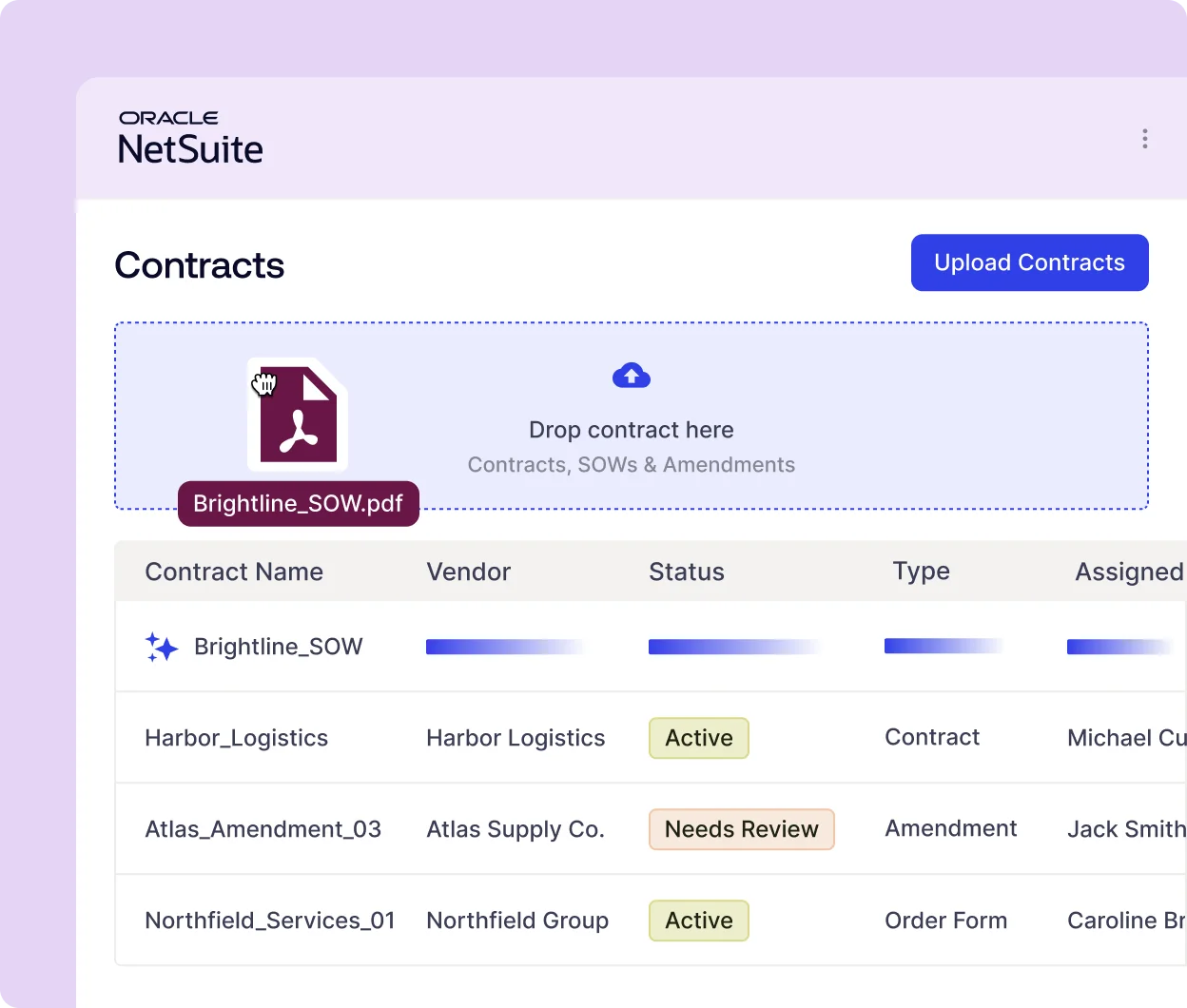
Drop contracts into NetSuite
Drag in contracts, SOWs, and amendments one at a time, or load a backlog in bulk. There is no separate upload portal and no shared drive to keep in step afterwards, because the document lands in the same system your AP team already works in all day.
Step 2
Charted AI agents read it and file it
Each document is read and matched to the right vendor, so it sits with the purchase orders and bills that vendor already has. Nobody has to name the file, pick a folder, or remember where the third amendment ended up.
Step 3
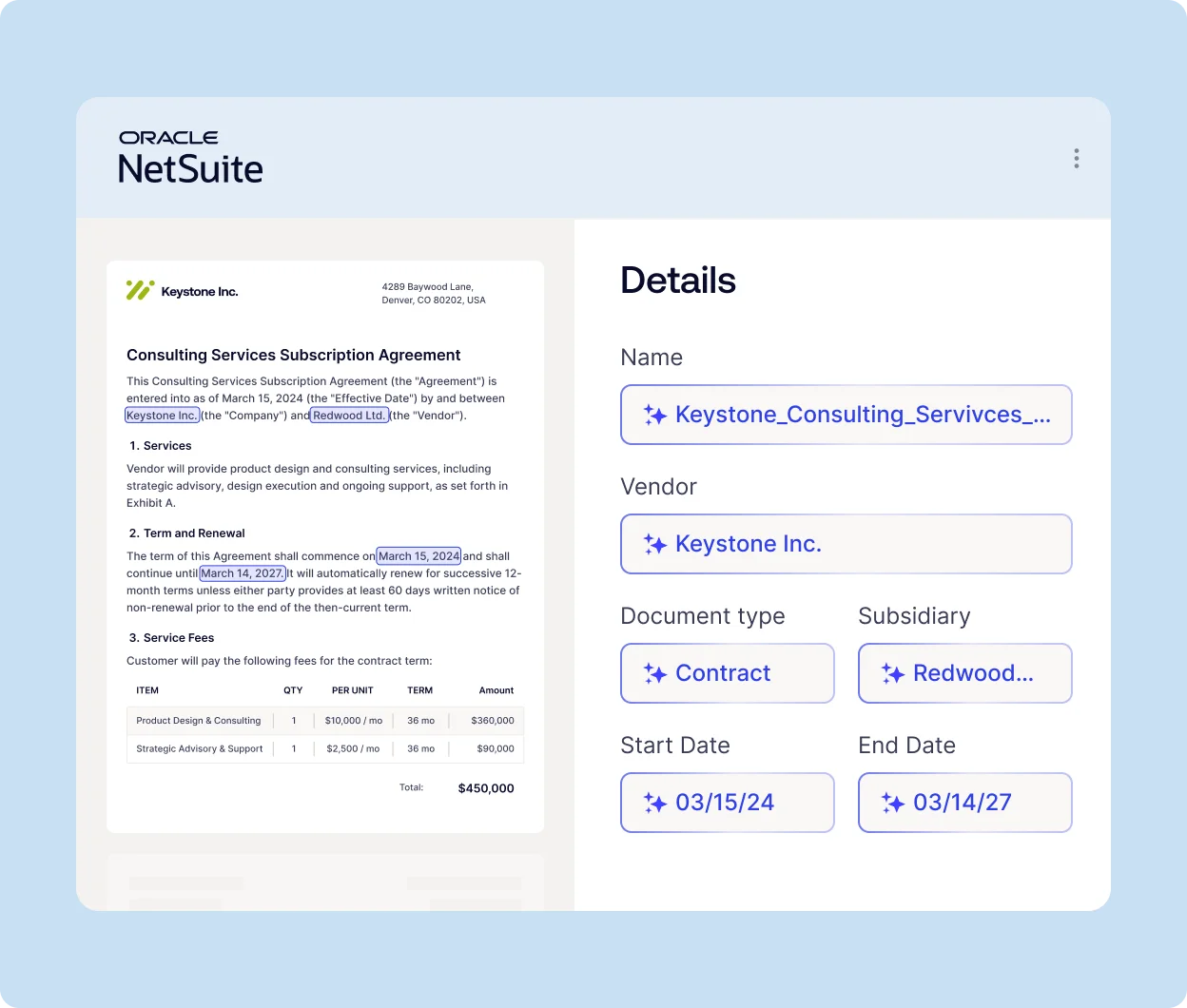
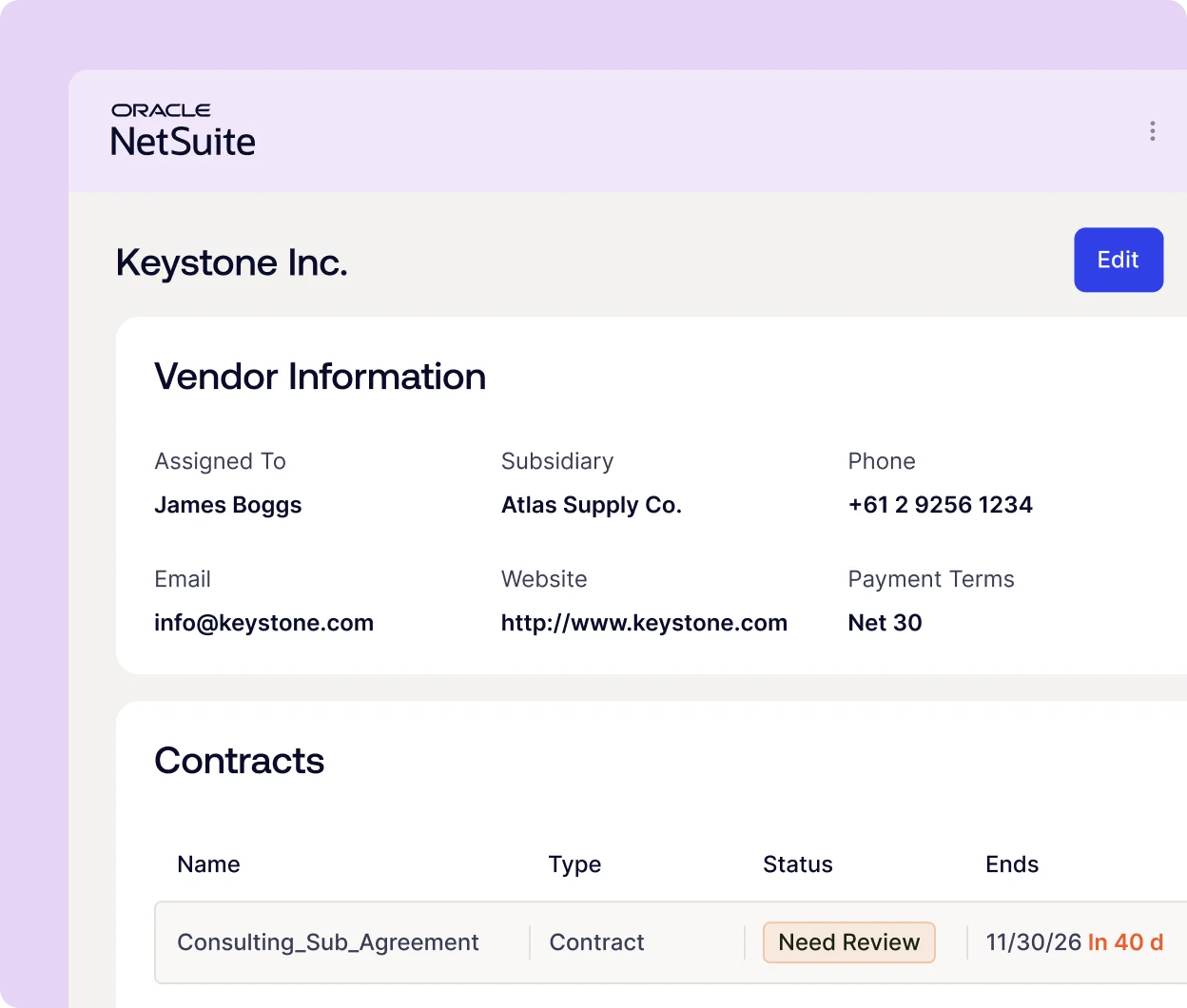
Terms become tracked fields for contracts
Key contract details, from vendor and contract type to dates, notice periods, auto-renewal status, total value and currency, are pulled out and written as fields and tracked. The commitment is readable at a glance by anyone looking at the vendor contract record, rather than buried on page 14 of an attachment nobody opens.
Step 4
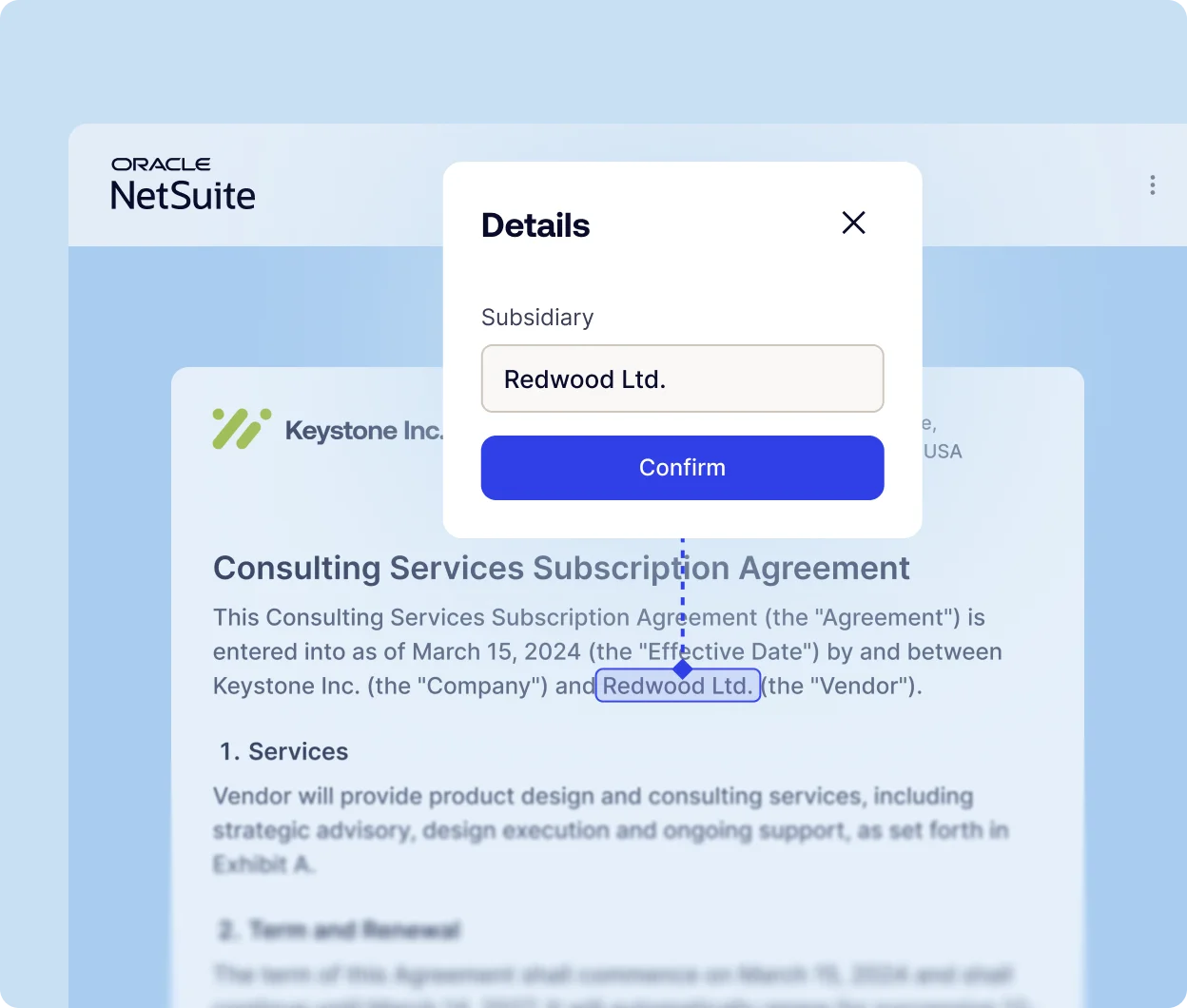
Every extracted term links to its source clause
Every extracted term links back to the source document with the passage highlighted, so a one-click check replaces rereading the agreement. AI extraction is good, and it still needs a person to confirm the dates you are going to act on. Verification is part of the step, not an afterthought.
Step 5
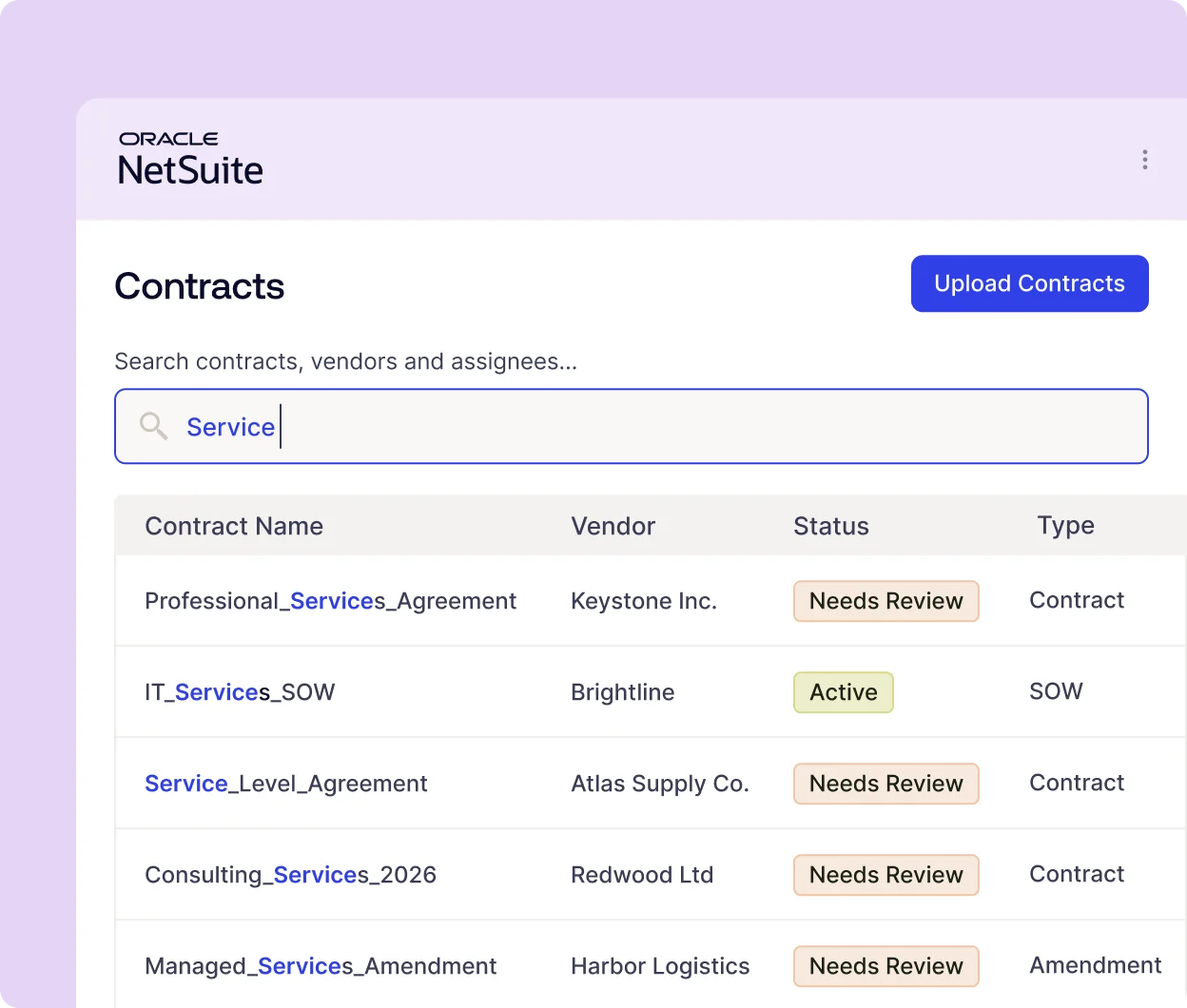
Searchable contract repository on the vendor record
Every contract, SOW, and amendment for a vendor sits in one searchable place on the vendor record. Finding a termination clause takes seconds instead of an email thread, a scroll through 40 pages, and a guess about which version was the one signed.
Step 6
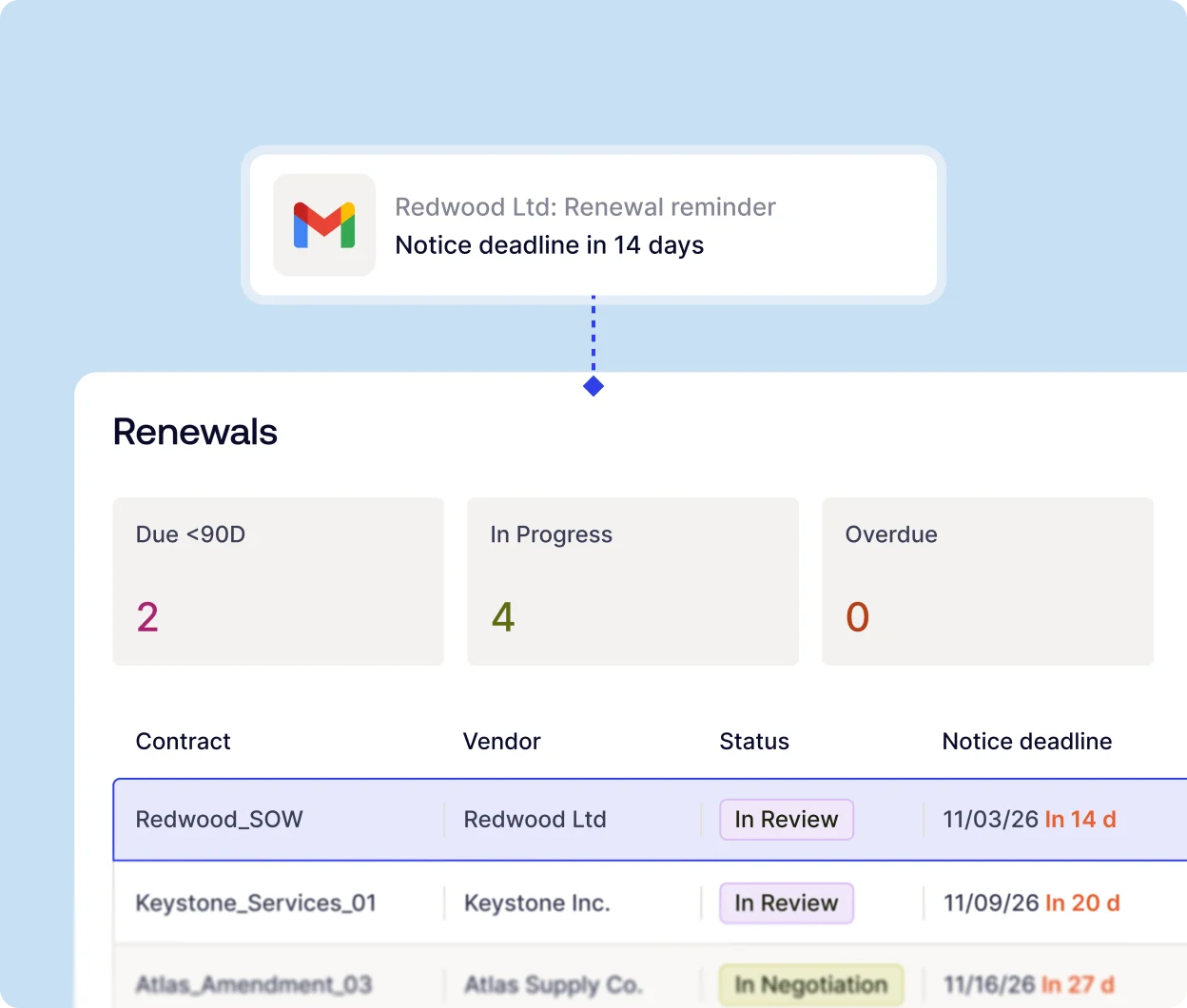
Renewal alerts and owner assignment for every vendor
Upcoming renewals, notice deadlines, and open actions sit in a single plan across all vendors. Email alerts fire while the notice window is still open, so you can renegotiate, cut scope, or cancel the contract. Assign a renewal to a named owner and it becomes a tracked NetSuite task that stays on the vendor record, even if that owner leaves.
What changes in your week?
Vendor contract management for finance, IT, and NetSuite admins
See every renewal and price increase while turning it down is still an option, with notice deadlines tracked against the vendor spend you already review in NetSuite. Today that question usually lands at budget review, after the commitment is made and the variance needs explaining.

Committed spend, escalation clauses, and payment terms sit on the vendor record, so what you accrue matches what you signed. No digging a PDF out of a shared drive to confirm a rate before close

Check payment terms, rates, and notice periods on the vendor record you already have open. Each extracted term links back to the passage it came from, so settling a disputed invoice takes seconds instead of a scroll through 40 pages.

Contracts are uploaded into NetSuite and stay in your own account. No external database, no middleware, no nightly export to reconcile, and no separate contract portal with its own feed for someone to fix when it breaks.

Access follows the NetSuite roles and permissions you already maintain, and all activity is logged in the audit trail. Nothing new to provision, no second user list, no sync errors to debug.






Frequently asked questions
It’s your signed vendor agreements stored in NetSuite on the vendor record, with the terms AP actually needs pulled onto the screen: term dates, auto-renewal language, and notice periods. Most teams keep those in a spreadsheet someone updates from memory, or in whatever folder the person who signed it used. Here the agreement sits next to the purchase orders, bills, and payments it governs.
On the NetSuite vendor record, inside your own account. Charted is a certified NetSuite SuiteApp, so there’s no middleware, no external database, and no contract portal for your team to log into.
Drag them into NetSuite, one at a time or in bulk. Charted AI reads each document and files it against the right vendor, so nobody is renaming files or deciding which folder they belong in.
Vendor, contract type, start and end dates, notice periods, auto-renewal status, total contract value and currency become fields on the vendor record. That answers when does this renew and how much time do we have, without anyone opening a 40-page agreement to find out.
Extraction gives you a first pass and your team confirms it. Click any extracted term and you see it highlighted in the source document, so checking a date takes seconds instead of scrolling a PDF. Once it’s confirmed it’s on the record for everyone, which beats re-reading the agreement every time someone asks.
Renewal Insights gives you one renewal plan across every vendor, with upcoming renewals, notice deadlines, and open actions in one view. Email alerts go out while the notice window is still open, so you can renegotiate, cut scope, or cancel instead of finding out when the invoice arrives. About half of installed software goes unused (Nexthink, 2023), so plenty of those renewals deserve a second look.
You give each renewal a named owner, and that creates a tracked task in NetSuite inside Charted. The renewal still has a name on it when the person who signed the original agreement has left.
No. If your legal team redlines drafts, negotiates with counterparties, and needs clause libraries and e-signature, that’s contract lifecycle management and a dedicated system handles it properly. Contract Intelligence picks up after signature and keeps the signed agreement beside the spend it governs. Plenty of finance teams run both.
Yes. Charted supports multi-currency, multi-entity, and multi-subsidiary AP, and contracts sit on the vendor record that already carries that structure. When three subsidiaries buy from the same vendor, the agreement is in one place instead of three shared drives holding three different versions.